Select projects and collaborations
HBCU Radio Preservation Project
Assistant Director of Public History & Programming, Website Project Lead, 2023-2026
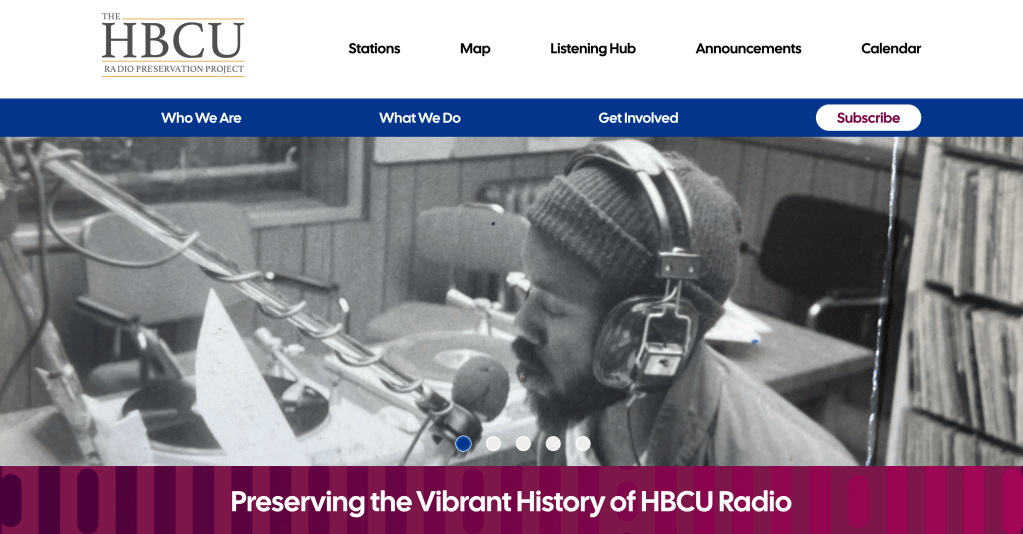
The HBCU Radio Preservation Project helps safeguard Black history and radio’s legacy. HBCU radio stations train students entering broadcasting careers and provide an outlet for communities to engage on issues while reveling in the sounds of the Black diaspora. Their rhythms and stories demand to be heard. And yet, the original programming created at HBCU radio stations is at risk of being lost. Magnetic tape and other obsolete formats are deteriorating, along with primary sources documenting the history and diversity of the Black experience. Environmental and administrative challenges, as well as fading memories compound these risks.
Our team acts with urgency to preserve HBCU radio history through outreach, collaboration, and audio-based storytelling while fostering an ethos of preservation among library and station leaders and their communities.
Designed in partnership with Creative Repute-–a firm that hires, supports, and empowers diverse graphic artists and media developers—this project website enables students, stations, and the public to navigate HBCU radio across an interactive map, listen to oral histories recorded on HBCU campuses, and engage with exhibits produced by our team. The site helps visitors learn about HBCU radio preservation opportunities, as well as original programming produced as HBCU radio broadcasts. People can also access original podcast recordings and a radio series created using audio and interview materials.
Washington, DC Women Speak
Researcher & Content Creator, 2022-2023

Washington DC Women Speak digitized and described over 300 oral histories archived in six historic collections. From July 2022 through October 2023, archivists listened to interviews and created individual online descriptions. They did so after digitization specialists recovered the recordings from deteriorating magnetic tapes and saved them in a digital format. I was one of two researchers who dug into this rich content to curate audio-stories for the site.
In their own voices, women of the Washington, DC area share memories, opinions and experiences of community. They talk about childhood, food, music, and schools, as well as the importance of history and the complexities of race and identity. Several women recall involvement in community-building work or the impact of political actions. Many express gratitude for those around them who shaped their neighborhoods and lives. These women’s perspectives bring fresh insights and topics to the fore. They renew conversations about community and belonging, collaboration, and the “silent leaders,” as one puts it, whose influence is felt if not always recognized. They speak to the connections and relationships that breathe life into a community.
Our Shared Future: Reckoning with Our Racial Past
Research Assistant, 2021-2022
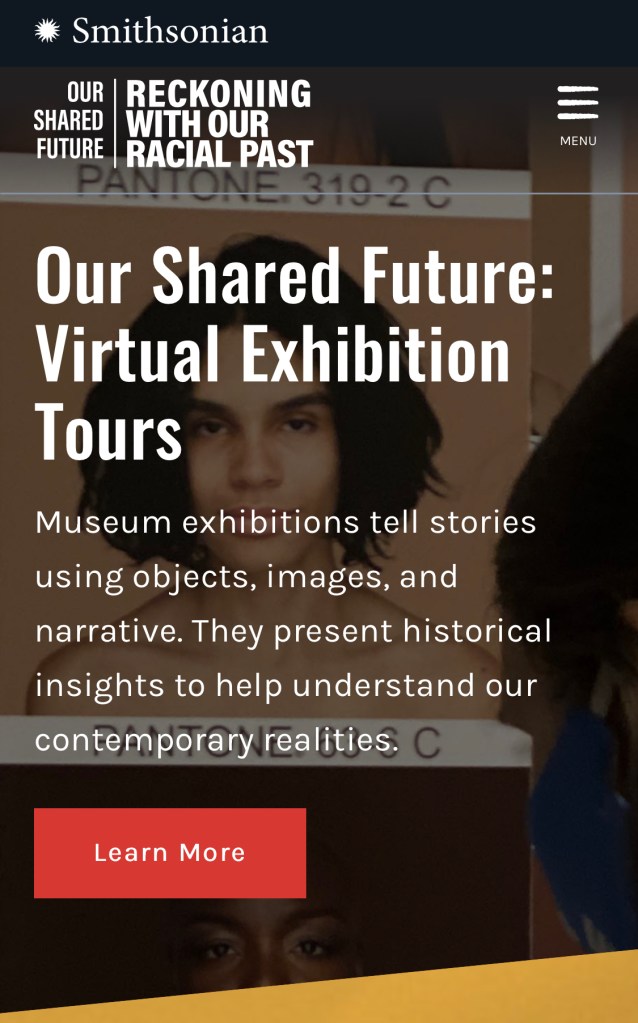
Our Shared Future: Reckoning with Our Racial Past is the Smithsonian’s first initiative dedicated to understanding how race and racism have shaped the U.S. and its foremost educational and research institution. Organized around six thematic pillars, the project represents a collaborative space for museum practitioners and citizens to explore how race and racism impact people’s lives on a day-to-day basis.
As a researcher on the project, I helped Smithsonian curators identify and field a range of archival and collections images, objects, videos, and documents in support of building mixed media content. This work included selecting digital assets for the Smithsonian’s award-winning Our Shared Future Forum, which explored issues of scientific racism and racial wealth and wellness gaps with experts, organizers, and curators. I also helped develop pillar explainer videos and provided logistical support for the initiative’s 3D digitization, oral history, and exhibition walk-through components.
African Americans in the Milwaukee Police Department
Creator and Interviewer, 2016-2018

The African Americans in the Milwaukee Police Department Oral History Project is comprised of twelve audio interviews with retired and current Milwaukee Police Department officers of African descent, as well as two African American University of Wisconsin-Milwaukee (UWM) Police Department officers. Narrators describe their experiences living and working in Milwaukee, Wisconsin, in addition to earlier places of residence. I conducted the interviews between 2016 and 2017 at officers’ homes, the UWM Cultures and Communities Program office, Wisconsin Black Historical Society and Museum (WBHSM), and the University of Memphis. WBHSM Director Clayborn Benson provided assistance with recruitment and coordination.
200 Nights of Freedom: March on Milwaukee 50th Anniversary
Oral History Committee Chair, 2017-2018
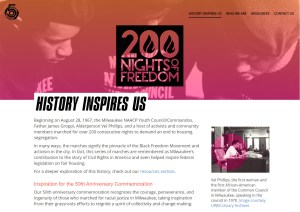
Serving as chair of the March on Milwaukee 50th Oral History Committee, I helped lead a collaborative effort to record community voices from the city’s 1967-1968 civil rights insurgency for open housing. Fifty years after the NAACP Youth Council led two hundred straight nights of protest in support of a local fair housing ordinance, our team of archivists conducted more than twenty-five oral history interviews at three strategic locations: Wisconsin Black Historical Society and Museum, the ACLU Youth Social Justice Forum at UW-Milwaukee, and Marquette University’s Raynor Library. Our team called these sites “listening posts” in honor of Black organizational efforts to document local instances of police brutality in 1967-1968. We asked community members to share physical artifacts or images from March on Milwaukee demonstrations as part of our “history harvests.” The committee was represented by five archival institutions: Wisconsin Historical Society, Wisconsin Black Historical Society, UW-Milwaukee Archives, Marquette Special Collections and University Archives, and Milwaukee County Historical Society.
In addition to recognizing past Black Milwaukee freedom fighters, archivists supported MOM50’s drive to re-ignite democratic engagement around issues of racial injustice from the grassroots. The oral history committee’s second harvest, for instance, partnered with the Wisconsin ACLU Youth Social Justice forum to record stories from contemporary activists alongside veterans of Milwaukee’s Black freedom struggle. The collection was cataloged by Wisconsin Historical Society and is available for research and educational use.
Transforming Justice: Action Research from the Ground-Up
Project Assistant & Web Developer, 2014-2015

Working as a graduate assistant on the Transforming Justice research project, I helped support workshop development, community outreach, and project conceptualization in a collaborative effort to build a grassroots history of mass incarceration in Milwaukee. UW-Milwaukee scholars, filmmakers, and local community members collectively re-framed conventional narratives around crime, health, safety, and justice. Workshops for Liberation featured scholars and organizers working at the vanguard of prison and police abolition and rethinking community safety in an age of rampant carceral capitalism. They included Ruth Wilson Gilmore, Mariame Kaba, and Rachel Herzing. The team’s Youth Video Collective, part of TJ’s counter media initiative, documented young people’s experiences with policing, racism and mass incarceration through powerful, self-directed video narratives.
Transforming Justice not only documented and gave voice to the above, but helped people on the ground develop strategies for re-defining security and health from the perspectives of individuals, families, and communities directly affected by policing and public/private surveillance. I designed the website, researched, and led social media engagement. The project’s faculty directors earned UW-Milwaukee’s 2016 Fromkin Award.
Note: This is a selection. Visit CV for full project listing.
 WILL TCHAKIRIDES, PHD